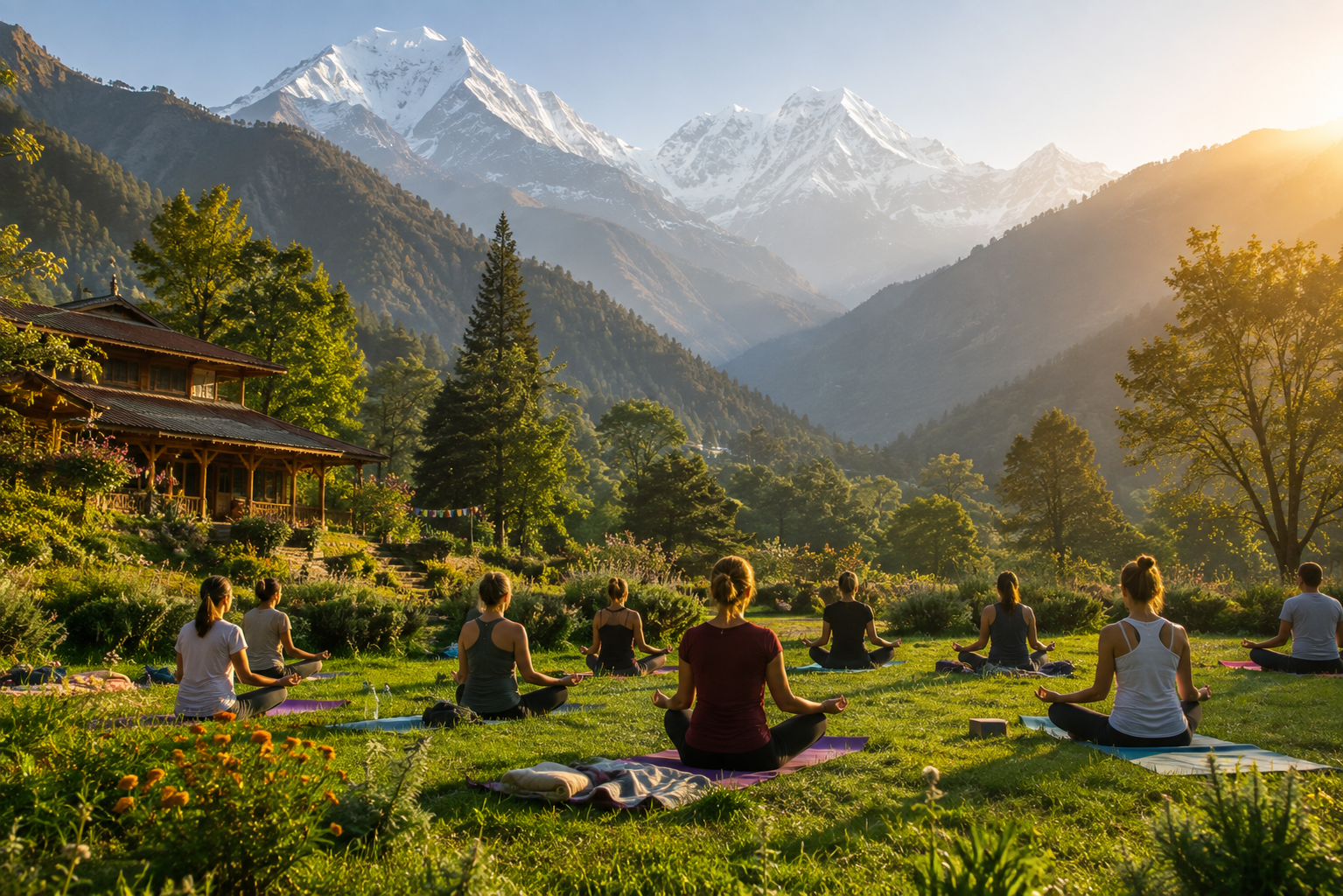
There are places you visit, and there are places that invite you to slow down.
Nepal can be one of those places.
Perhaps it is the sight of prayer flags moving in the mountain air, the sound of chanting around an ancient stupa, the quiet of a Buddhist monastery, or the first light appearing over the Himalayas. Perhaps it is simply being somewhere far enough from your usual routine that you finally have time to notice how you are feeling.
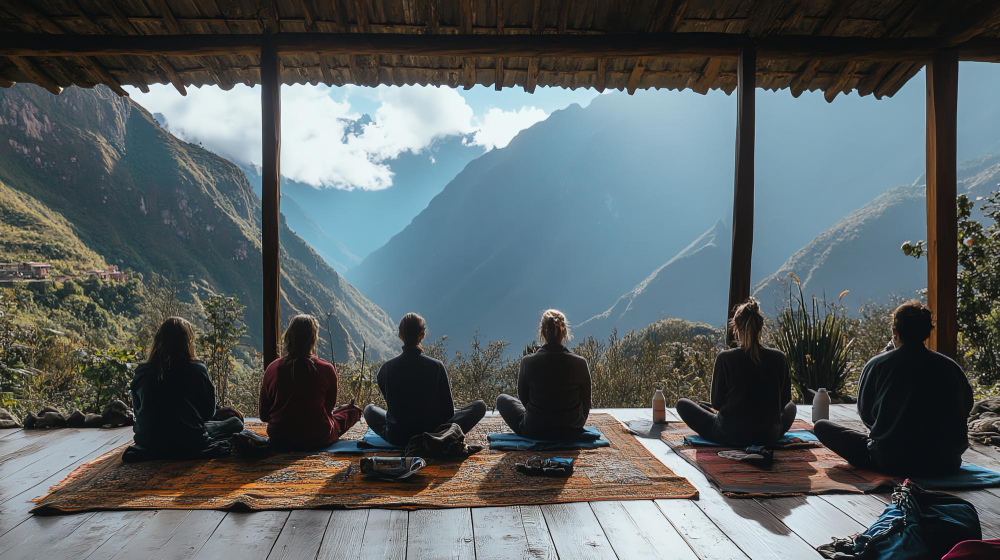
For anyone drawn to yoga, meditation and inner reflection, Nepal offers a particularly interesting setting for a retreat. Yoga and meditation are not separate from the culture and landscape around you. They become part of a wider experience that includes Buddhist traditions, sacred spaces, ancient cities, mountain views and a slower pace of living.
This is the idea behind Whispers of the Himalayas, an 8-day Nepal Yoga Retreat hosted by Adi Yoga Shala from 15–22 October 2026. The journey takes us through Kathmandu and Pokhara, combining daily yoga and meditation with pranayama, sacred and cultural experiences, Himalayan sunrise moments, sound healing, and time to simply rest and explore.
But what is it about Nepal that makes it such a special place for a yoga retreat?
What Makes a Nepal Yoga Retreat Special?
Nepal is often introduced to travellers through the Himalayas, but its appeal goes much deeper than the mountains.
For centuries, Hindu and Buddhist traditions have shaped the country, and spirituality remains visible in everyday life. Monasteries, temples, stupas, prayer flags and sacred sites are not simply historical attractions. They are living places where people continue to pray, meditate, make offerings and practise their traditions.
For someone coming to Nepal for a yoga retreat, this creates an environment that naturally encourages awareness.
That does not mean that travelling to a spiritual destination will somehow do the inner work for you. Meditation is still meditation, wherever you practise it. Yoga is still a personal practice. But changing your surroundings can change your relationship with your own time and attention.
At home, our days are often filled before they have even begun. There are messages to answer, work to finish, people to see and responsibilities waiting for us. Even when we take a holiday, we can end up filling every day with places to visit and things to photograph.
A retreat creates a different rhythm.
You wake up, practise, eat, explore, rest and return to yourself. There is structure, but there is also space. And in Nepal, all of this happens within a landscape and culture that continually remind you to slow down and observe.
This is what we wanted to create with Whispers of the Himalayas. Rather than organising a retreat where every hour is occupied, the journey brings together meaningful experiences with enough space to actually experience them.

Kathmandu: The Spiritual Beginning of Your Nepal Yoga Retreat
Kathmandu is energetic, colourful and sometimes chaotic. It is also home to some of Nepal’s most important Buddhist and Hindu sites.
For the first part of the retreat, Kathmandu gives us an opportunity to experience the cultural and spiritual side of Nepal before travelling towards the quieter surroundings of Pokhara.
One of the places we visit is Kopan Monastery, situated on a hill overlooking Kathmandu. The monastery is known for its Buddhist teachings and peaceful surroundings, and spending time there offers a very different experience from simply visiting another tourist attraction.
There is something valuable about being in a place where people have come for centuries to study, contemplate and practise. You don’t have to understand every teaching or have a background in Buddhism to appreciate the atmosphere. Sometimes it is enough to sit quietly, observe and allow yourself to be present.
From Kopan, the journey continues to Boudhanath Stupa, one of Nepal’s most significant Buddhist sites.
The great white stupa, surrounded by monasteries, prayer flags, incense and the steady movement of people walking the kora, is one of the experiences that stays with many visitors to Kathmandu. It is a place where you can see spiritual practice happening all around you.
For us, this is an important part of a Nepal yoga retreat. Yoga does not need to remain confined to the yoga mat. The practices of awareness, observation and presence can continue as you move through the world.
Nagarkot and the Himalayan Sunrise
One of the most beautiful moments of the Kathmandu part of the retreat comes early in the morning when we travel to Nagarkot for sunrise.
There is a particular quality to being awake before the rest of the day has begun. As the light slowly changes, the Himalayan landscape gradually reveals itself. On a clear morning, the mountain ranges become visible in the distance.
It is easy to understand why mountains have been associated with contemplation and spiritual seeking for so long.
You don’t necessarily need a guided meditation or a particular technique in a moment like this. Sometimes standing quietly and watching the landscape change is enough.
After sunrise, we continue to Bhaktapur Durbar Square, where temples, courtyards and traditional architecture offer another perspective on Nepal’s history and culture.
The contrast is part of what makes the journey interesting. One moment you are looking towards the Himalayas in silence; a few hours later you are walking through an ancient city surrounded by intricate craftsmanship and centuries of history.
Yoga, Pranayama and Meditation Throughout the Retreat
Although the places we visit are an important part of the experience, yoga remains at the centre of the retreat.
Each day includes yoga and meditation, together with mindful breathwork and pranayama. The intention is not to push participants towards physical achievement or create a demanding schedule of advanced practices.
People come to retreats for different reasons.
Someone may already have a strong yoga practice and want to deepen it in a different environment. Someone else may be completely new to yoga and simply want to experience what it feels like to practise consistently for several days. Another person may be more interested in meditation, breathwork or the opportunity to spend some time away from their usual life.
The practice therefore needs to leave room for individual experience.
Morning yoga provides a way to begin the day with awareness rather than immediately rushing into activity. Breathwork brings attention back to the body and breath, while meditation creates a little space between ourselves and the constant movement of the mind.
The intention is not to become a different person during eight days in Nepal.
It is simply to become a little more present to the person you already are.
From Kathmandu to Pokhara
After experiencing Kathmandu, the retreat moves to Pokhara.
The atmosphere changes noticeably.
Pokhara is surrounded by mountains and centred around Phewa Lake, and its lakeside area has a much slower rhythm. After several days of exploring Kathmandu and its surrounding cultural sites, this change of pace allows the group to settle into a quieter part of the journey.
The afternoon after arriving in Pokhara is intentionally open.
There is time to walk beside the lake, sit somewhere with a cup of tea, explore the Lakeside area, journal or simply rest. Not every part of a retreat needs to be an organised activity.
In fact, having nothing particular to do can sometimes be one of the most valuable parts.
The evening brings us back together for yoga and meditation before dinner.
This balance between shared experience and personal space is important to the way we approach retreats at Adi Yoga Shala.
Sarangkot: Beginning the Day With the Himalayas
The following morning begins early again, this time with a journey to Sarangkot.
Sarangkot is known for its Himalayan views, particularly at sunrise. When the weather is clear, the mountains gradually appear as the sky changes colour and the first light reaches the peaks.
We take time for meditation there as well.
Meditating in front of such a landscape can be a memorable experience, but the purpose is not to make the mountains responsible for your meditation. The landscape simply gives you a different place to sit with yourself.
After several days of travel, yoga and exploration, the retreat then moves into a slower experience with a sound healing session with a local healer.
Sound healing offers another way of working with stillness. Rather than asking you to concentrate or achieve anything, it allows you to lie back, listen and rest.
The remainder of the day remains relatively spacious.
That is deliberate. A retreat should give you enough experiences to feel that you have travelled somewhere, but not so many that you return home needing another holiday.
The World Peace Pagoda and a Day to Yourself
Another highlight of the Pokhara experience is a visit to the World Peace Pagoda, which sits above Phewa Lake with expansive views towards the surrounding mountains.
After morning pranayama and yoga, we visit the pagoda and spend time in the area before returning to Pokhara.
The afternoon is free.
You might explore the Lakeside area, find a café, take a walk, or simply stay somewhere quiet with your journal. There is no requirement to make the afternoon productive.
This is something I believe is often missing from organised retreats. When every moment is planned in the name of creating an “experience”, there can be very little room left to actually experience how you feel.
So some of the time on this retreat is intentionally unstructured.
The evening closes with a candlelight meditation, bringing everyone back together after a quieter afternoon.
What Is a Nepal Yoga Retreat Really Like?
A yoga retreat in Nepal does not have to mean spending every day sitting in meditation or practising yoga for hours.
For us, it is about bringing yoga into the way you experience the whole journey.
You practise in the morning. You notice your breath while travelling. You walk through a sacred place and observe rather than rushing through it. You sit beside a lake. You watch the mountains at sunrise. You have conversations with people you have only just met. You spend an afternoon doing absolutely nothing.
All of these experiences can become part of the retreat.
That is also why Whispers of the Himalayas is not designed exclusively for experienced yoga practitioners.
You do not need to be flexible. You do not need to have years of meditation experience. You do not need to consider yourself a spiritual person.
You simply need to be open to experiencing Nepal at a slower pace.
A Retreat for Solo Travellers, Beginners and Experienced Practitioners
One of the lovely things about a small retreat group is that people can arrive with completely different reasons for being there.
Some may be experienced yoga practitioners looking for a deeper connection with their practice. Others may be travelling alone and looking for the security and companionship of a small group. Some may be beginners who are curious about yoga and meditation but have never attended a retreat before.
There is no expectation that everyone will have the same experience.
You can participate in the group practices and shared excursions while still having time to yourself. You can have breakfast with everyone and spend the afternoon alone. You can join every activity or take some quiet time when you need it.
The retreat is shared, but your experience of it remains personal.
Why Combine Kathmandu and Pokhara for a Yoga Retreat in Nepal?
One of the reasons I chose Kathmandu and Pokhara for this retreat is that they offer such different experiences of Nepal.
Kathmandu brings you closer to the country’s history, Buddhist traditions, architecture, and sacred spaces. Kopan Monastery, Boudhanath and Bhaktapur each reveal something different about the culture.
Pokhara gives you more space and a different relationship with nature. Phewa Lake, Sarangkot and the World Peace Pagoda create a quieter setting for the second half of the retreat.
Together, they allow the journey to move naturally from cultural exploration towards rest and reflection.
Rather than staying in one place for eight days, you experience two distinct sides of Nepal.
Your 8-Day Nepal Yoga Retreat Itinerary
Whispers of the Himalayas begins in Kathmandu on 15 October and ends in Pokhara on 22 October 2026.
The first day is intentionally gentle. After arriving in Kathmandu, you have time to settle in and rest before meeting the group for an opening circle, grounding meditation, and welcome dinner.
The following days bring together morning yoga and meditation with visits to Kopan Monastery and Boudhanath, followed by the early morning Himalayan sunrise at Nagarkot and a visit to Bhaktapur.
We then travel to Pokhara, where the pace changes. Time beside Phewa Lake is followed by the Sarangkot sunrise and meditation, sound healing with a local healer and a visit to the World Peace Pagoda.
The final full day is deliberately slower, with morning practice, free time and an evening closing ceremony and farewell dinner.
On the eighth day, the retreat comes to an end in Pokhara.
The itinerary gives you a sense of structure, but it is not designed to make you feel as though you are being moved from one activity to the next.
There needs to be room for the unexpected moments too.
What Makes This Retreat Different?
There are many yoga retreats around the world, and Nepal is certainly not the only beautiful place to practise.
What makes this journey different is the combination of experiences.
You are not simply staying at a retreat centre and practising yoga for a week. You are travelling through Nepal while keeping yoga and meditation as the thread connecting the journey.
One day you may be walking around Boudhanath surrounded by prayer flags and chanting. Another morning you may be watching the Himalayas appear from Sarangkot. Later, you may be sitting beside Phewa Lake with nowhere you need to be.
- There is movement, but there is also stillness.
- There is culture, but also personal space.
- There is a group, but also time alone.
That balance is at the heart of Whispers of the Himalayas.
About Adi Yoga Shala and Your Host
Choosing a retreat is also about choosing who you will spend those days with and who will guide your practice.
I am Iraa, founder of Adi Yoga Shala and a yoga teacher with more than 11 years of teaching experience. I hold a Master’s degree in Yoga and have a teaching background in Hatha Yoga, Pranayama, Yoga Philosophy, Anatomy and Yin Yoga.
Over the years, I have taught students from different countries and backgrounds and have led retreats and yoga teacher training programmes internationally.
For me, teaching a retreat is not about trying to create a particular emotional outcome for someone.
It is about creating a space where people can practise, explore, rest and experience something outside their normal routine.
Nepal is already an extraordinary place.
The retreat simply allows you to experience it with a little more intention.
Is Nepal Calling You?
Some places are difficult to explain without making them sound more mystical than they really are.
Nepal is perhaps one of them.
It may be the mountains. It may be the Buddhist monasteries and ancient temples. It may be the prayer flags moving in the wind or the sound of bells and chanting around a stupa.
Or perhaps what stays with you has nothing to do with any of those things.
Perhaps it is waking before sunrise.
Perhaps it is sitting beside Phewa Lake with no plans for the afternoon.
Perhaps it is a conversation with someone you met only a few days earlier.
Perhaps it is noticing your own breath after several days away from the usual noise of life.
That is what I hope Whispers of the Himalayas can offer.
Not a promise that eight days will change your life.
Not an escape from everything you normally have to deal with.
Simply a little distance from the familiar, and enough time to experience yourself and Nepal differently.
Join Whispers of the Himalayas: Nepal Yoga Retreat (15–22 October 2026)
From Kathmandu to Nagarkot, Bhaktapur and Pokhara, this 8-day Nepal Yoga Retreat brings together daily yoga and meditation, pranayama, sacred Buddhist spaces, Himalayan sunrise experiences, sound healing, nature and time to rest.
It is for experienced practitioners and beginners, solo travellers and those travelling with friends, and anyone who wants to experience Nepal in a more meaningful way than a conventional sightseeing holiday.
If you have been looking for a Nepal yoga retreat, a Himalayan yoga retreat or simply a different way to experience Nepal, perhaps this is the journey you have been waiting for.
Whispers of the Himalayas is a journey through yoga, meditation, mountains, culture and stillness — with enough space for you to discover what the journey means to you.
FAQ
Q1. Is Nepal good for yoga?
Yes, Nepal is considered to be a great place for yoga. A naturally spiritual, peaceful setting, rich in Hindu and Buddhist tradition, nestled in the Himalayas. Kathmandu, Pokhara and the surrounding hill areas have it all, from basic ashrams to full-service yoga resorts for beginners, serious practitioners, and teacher trainees alike.
Q2. Is Nepal known for meditation?
Yes, Nepal is also a major pilgrimage and meditation destination because it is the birthplace of Lord Buddha in Lumbini, which is very special. Meditators from around the globe flock to monasteries such as Kopan, near Kathmandu. Nepal is known for its tranquil mountain landscapes that promote reflection.
Q3. Can a retreat change your life?
A retreat can be truly life-changing, leaving the daily stress behind and diving into some focused yoga or meditation, and often bringing clarity, healing, and a new perspective. But lasting change is about what you do after. The retreat opens the door; you have to walk through it.
Q4. Is Nepal good for a meditation retreat?
Yes, Nepal is one of the best places for meditation in the world. It is the birthplace of the Buddha (Lumbini) and has monasteries and traditions of spirituality centuries old. The Himalayan setting only adds to the experience with its quiet valleys, mountain air, and slower pace that makes it easy to settle into stillness. Kathmandu Valley, Pokhara and Lumbini are popular bases with seasoned teachers and a culture where meditation is a lived practice, not a fad.
Q5. Is this Nepal yoga retreat suitable for solo travellers?
Yes, solo travellers are a big part of the guests. Shared meals, group sessions and communal accommodation all build a sense of community, and so even if you arrive on your own, you’re rarely on your own. Overall, Nepal is a welcoming and safe place to travel alone, and most retreats take care of airport pickup, on-site support and a set itinerary, so you don’t have to navigate a new country on your own.

Leave a Reply